Sira'at
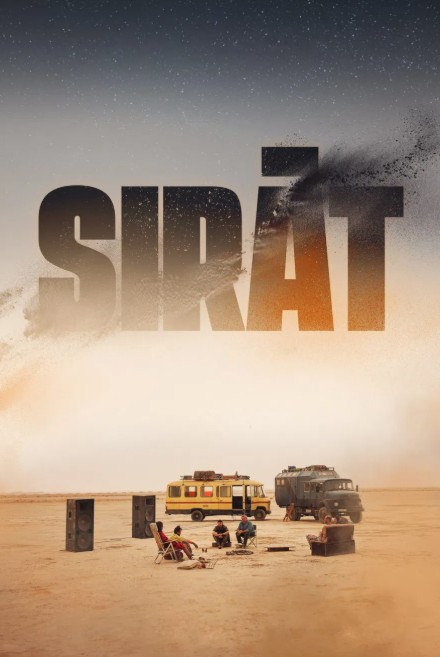
Watched Sirat (2025), maybe so you don't have to. But if you do watch it, just be warned that it deliberately defies the expectations that it builds in us early on.
The film begins with a father searching, with his son, for a missing daughter, who they believe may be at a trance music festival taking place in the desert of an unnamed North African country. In the morning, the army shows up to break up the party and escort all the Europeans out of the place, because some sort of insurrection has broken out, and it is no longer safe for them to be there. However, a small group break away from the military escort in search of yet another festival that is supposed to be taking place, and the father and son follow them on a difficult journey through the desert.
This is a difficult-to-watch, but significant movie, which cries out for careful consideration.
Maybe it is trying to tell us that it is useless to look for easy escapes (like music and dance) from the harsh reality we live in. Even if, like the characters, we think we may have really earned, or desperately need, such escapes.
In that spirit, the film made me think of the Nova Music Festival in October 2023, where young Israelis danced all night and in the morning were massacred.
Or I could think of the Hamas fighters that broke out of the huge prison that is Gaza on that day, to enjoy a crazed moment of mayhem and blessed martyrdom (from their point of view), leading to the near total annihilation of Gaza.
On the other hand, maybe the film wants to tell us that the only way to cross the narrow bridge - the "Sirat" of the movie's title - between hell and heaven, is to put aside our fears and traverse life's minefield without thinking or worrying about the consequences, be they cruel or kind. It's all a crazy dance anyway.
The film hints that all of humanity is on such a narrow bridge. We are packed into a locomotive, speeding on narrow tracks across a vast desert, into the unknown.
There is a Jewish Hasidic song that says, "The whole world is a narrow bridge, a very narrow bridge - and the important thing is not to fear at all."
A friend pointed out:
"in Arabic, ‘Sirat’ (صراط) literally means ‘path’, “way”, or ‘trail’. In a religious context, particularly in Islam, it often refers to the ‘right path’ or ‘path of righteousness’ leading to God. It has strong spiritual and moral connotations. Derivatives such as Siraj, meaning “lamp” or ‘light’, can be associated with this name, sharing a similar root and symbolism of guidance."
To which I responded:
I didn't know that the word Sira'at is in Arabic and means "path" rather than "bridge"[he later qualified that "bridge" can be a meaning], as they translated it in the English subtitles - this indeed fits even better. But probably the idea is still very similar to the meaning of the Hasidic song that I mentioned, as well as that of the New Testament verse "Enter ye in at the strait gate: for wide is the gate, and broad is the way, that leadeth to destruction, and many there be which go in thereat:" (Matthew 7:13-14 - I had to look it up).
But if the idea of Sira'at is of a "path of righteousness that only the very few can walk", whereas the vast majority will always be led astray, I am not sure this is exactly what the film makers had in mind (remembering the very last scene in the film). It's as if we are all - all of humanity, in its different shades and colours, speeding along this narrow gauge track, traumatized by our past and surrounded by ever-present danger as we continue into the unknown.
I think the narrow path described is more like the way of the Tao Te Ching: a way that we can safely traverse only when we stop attempting to discern or define it, in a place where Heaven and earth do not act out of any wish to be benevolent.
Some relevant verses of Lao Tsu:
The Tao that can be told is not the eternal Tao.
The name that can be named is not the eternal name…
Between birth and death,
Three in ten are followers of life,
Three in ten are followers of death,
And men just passing from birth to death also number three in ten.
Why is this so?
Because they live their lives on the gross level.
He who knows how to live can walk abroad
Without fear of rhinoceros or tiger.
He will not be wounded in battle.
For in him rhinoceroses can find no place to thrust their horn,
Tigers no place to use their claws,
And weapons no place to pierce.
Why is this so?
Because he has no place for death to enter